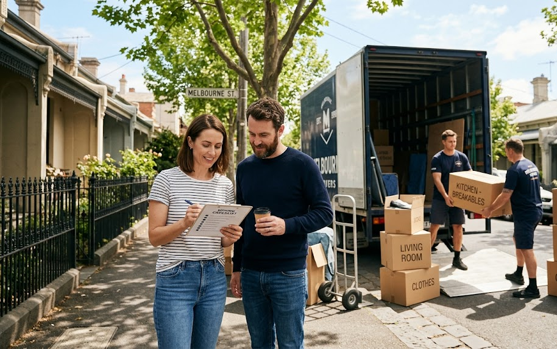
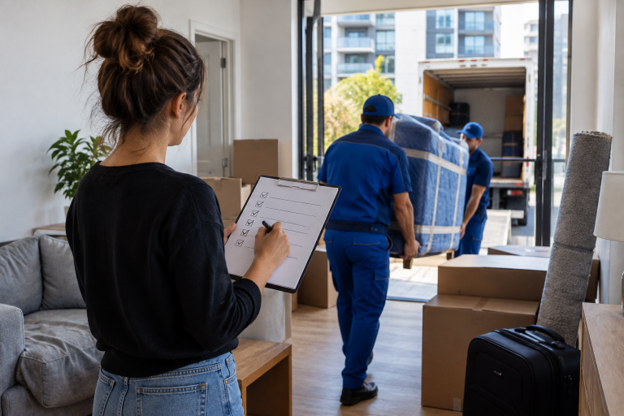
Today, you're going to learn exactly how to move furniture into a Melbourne terrace house.
Not the easy stuff.
The kind of moves that actually work , when you're staring down a 750mm hallway, a spiral staircase built in 1888, and a king-sized bed that absolutely will not fit around the corner.
At the pointy end of Melbourne's inner-city rental and buying market, Victorian terrace houses are everywhere.
The truth is that standard removalists quote for standard homes, but terrace houses aren't standard homes. They were built in an era when furniture came in pieces and was assembled inside the room. Nobody in 1890 was trying to move a modular sofa through a 76cm doorway.
So what's changed?
The furniture has gotten bigger. The doorways haven't.
And that gap between what modern furniture looks like and what 19th-century architecture allows is exactly where most Melbourne terrace moves go wrong.
In this guide, I'll show you:
Let's be clear about what we're dealing with.
Victorian terrace houses, the kind built between roughly 1850 and 1910 across Carlton, Fitzroy, and Parkville were designed around a very different way of living.
Narrow frontages, two-storey layouts, shared walls, and ornate facades with wrought-iron lacework hiding deeply impractical interior geometry.
The typical features that make them beautiful are the same features that make them a nightmare to move into:
This isn't a minor inconvenience. It's a structural reality that requires a completely different approach to furniture access.
That's the mindset shift.
You're not just moving furniture. You're solving an architectural puzzle every single item, one at a time.
Here's something most people don't know:
That ornate first-floor balcony on your Fitzroy terrace? It might be the best access point in the entire building.
Balcony hoisting - sometimes called furniture lifting or vertical hoisting involves using a mechanical hoist or pulley system to lift furniture from street level directly up to a first-floor balcony. The furniture bypasses the front door, the hallway, and the staircase entirely.
For certain items, it's not just easier. It's the only way.
When balcony hoisting is the right call:
The balcony becomes the access point. And in most Carlton and Fitzroy terraces, the first-floor balcony opens directly into the master bedroom or the main living area, exactly where the hardest-to-move items need to go anyway.
A specialist team will assess the balcony structure before committing to a hoist. Wrought-iron lacework balconies that are decorative only can't bear load — so the hoist typically attaches to a portable A-frame or extending arm positioned above the balcony, not to the balcony railing itself.
The furniture is wrapped, strapped into a lifting harness, and raised vertically. One or two team members on the balcony guide it over the railing. On the street side, a third person manages the hoist and maintains tension.
The whole lift for a single item takes roughly 10 to 20 minutes.
Multiply that across five or six problem items, and you've still saved hours compared to the alternative: trying to force, tilt, and argue furniture up a 95cm staircase that makes a 90-degree turn at the top.
If they hesitate on any of those three, keep looking.
Most people don't even consider this.
But for certain rooms and certain items, removing a window is faster, cheaper, and safer than any other access method.
This is especially true for:
Victorian sash windows, these double-hung timber-framed windows common on terraces built in the 1880s and 1890s, are actually designed to be removed relatively easily. The sashes slide out of the frame once the staff beads are removed. A skilled tradesperson can have a window out and back in within 30 to 45 minutes.
What you gain is an opening typically 800mm to 950mm wide and 1000mm to 1200mm tall. Not a huge difference from the door frame on paper. But the key is what surrounds it.
Unlike a doorway, a window opening has no 90-degree hallway pivot. No low ceiling. No corner that needs to be negotiated. The furniture travels in a straight line, up from outside, through the window, and directly into the room.
For a king bed base, a large wardrobe, or a full-length mirror. That straight-line access changes everything.
Window removal on move day needs to be pre-agreed, not improvised. Your removalist needs to confirm:
Don't leave this to the day-of conversation. In a Fitzroy or Carlton terrace, move day is usually already tight on time and street parking. Adding an unplanned window removal into the mix creates chaos.
Plan it upfront. Confirm it in writing.
Here's the hard truth about terrace house staircases:
Most furniture that "should" fit on paper, won't because paper doesn't account for the pivot.
The staircase in a Victorian terrace narrows and it turns. And it turns at the exact moment when you're most committed, carrying the full weight of the item, with zero room to reposition.
Here are the practical techniques that experienced narrow access removalists in Melbourne actually use:
For mattresses, sofas (where a section can be removed), and certain dressers, a combination of tilting to an acute angle and sliding along the wall can work, if the staircase ceiling allows it.
The critical measurement is the diagonal of the item, not just its height or length. A mattress that's 200cm long, when tilted to 45 degrees, has an effective height of roughly 141cm. If your staircase ceiling at the pivot point clears that, you're through.
This is why measuring before move day isn't optional. It's the whole job.
The single most underused solution in terrace house moves. If a wardrobe came flat-packed, it can go flat-packed. Bed frames should always be disassembled before attempting a terrace staircase .
But it goes beyond obvious flat-pack items. Experienced removalists know how to remove:
None of these modifications are permanent. Everything goes back together in the room. But the difference between a 180cm wardrobe and three panels of timber that stack flat is the difference between a successful move and a stuck piece of furniture wedged into a Victorian staircase at 11am.
Tight staircases mean walls take a beating. Proper blanket wrapping on all furniture items protects the piece and the plasterwork. Furniture sliders reduce friction during the tilt-and-slide, making repositioning mid-staircase manageable rather than a two-person deadlift argument.
This one matters more than people want to admit.
If an item won't fit safely through the staircase, forcing it rarely ends well. Cracked plaster on a heritage listed terrace wall is an expensive fix or back injury halfway up a steep Victorian staircase is worse.
The right call is to pivot to one of the other solutions: hoist it to the balcony, remove a window, or reassess whether the item belongs in the room it's headed for.
A good removalist will tell you this before attempting. A bad one will try anyway and hand you the repair bill at the end.
Not every removalist is equipped for terrace houses. Not even close.
Here's what to look for and what to ask before you book anyone to move you into a Carlton, Fitzroy, or Parkville terrace.
Ask them directly: "Have you moved furniture into Victorian terrace houses in Carlton or Fitzroy?" If they hedge or pivot to generic "narrow access" experience, dig deeper. Inner Melbourne terraces have specific quirks, the sash windows, the wrought-iron balconies, the plaster walls that are different from a townhouse in the eastern suburbs.
Some removalists will quote for a balcony lift but subcontract the hoist to a third party. That creates a coordination problem on move day. Look for teams that carry their own equipment and have used it recently.
Any competent narrow access removalist in Melbourne will want to see the property before they quote or at minimum review photos and floor plans and ask the right questions. If someone quotes you blind over the phone for a terrace house move, they're either experienced enough to already know what they'll find, or they're not accounting for the complexity at all. Ask which one it is.
Before move day, you should have confirmed:
King and Queen Mattresses: Almost never make it up a Victorian staircase without a tilt that the ceiling won't allow. Balcony hoist is usually the answer.
Modular Sofas: The individual sections are manageable. The problem is the chaise component, which is often 160cm+ on the longest axis. Measure it diagonally.
Large Wardrobes: Disassemble if at all possible. If not, window removal is usually the cleanest solution for a second-floor bedroom.
Dining Tables: Extension tables with a central pedestal base are deceptively hard. The base alone can be 90cm in diameter. Know this before move day.
Large Artworks and Mirrors: Often overlooked until the last minute. Tall, fragile, and awkward. These need dedicated handling, not an afterthought at the end of the job.
Moving into a Melbourne terrace house isn't just a removal job.
It's an access problem. And access problems need to be solved before the truck arrives, not improvised on the day.
The best terrace house moves happen when three things align:
In short, don't book a standard removalist for a non-standard house.
Find narrow access removalists in Melbourne, confirm they have hoisting capability, and do the measuring before anything else.
Your 1890s terrace is one of Melbourne's finest architectural achievements.
Getting your furniture in? That just takes the right team.
LOCATIONS & SUBURBS
From moving houses to office relocation services in records time, we’ve got the lowest removalist costs in Melbourne – Book your next move with us online today! For our interstate removalists – try Move4Cheap!
© Copyright 2024 - Melbourne Cheap Movers - All Rights Reserved | Designed, Marketing & Managed by Crazy Rise