Apartment moves in Melbourne rarely go wrong because of the furniture. They go wrong because of a form nobody filled in, a lift nobody booked, or a truck parked somewhere it wasn't allowed to be. Unlike a house move, where you can usually just back a truck up to the front door, an apartment move depends on other people's schedules and other people's rules.
Most Melbourne apartment buildings require a booked lift slot, formal approval from the owners corporation or building manager, and a legal place for the truck to park before loading can start. Getting these three things confirmed in writing, ideally two to three weeks out, is what separates a two hour move from a half day one.
Reliable Melbourne removalists who work in apartment buildings every week will usually chase this paperwork for you, but it still helps to know exactly what's being asked for and why.
A house move is largely between you and your removalist. An apartment move adds two more parties with their own approval process: the building (owners corporation and building/facilities manager) and the local council (which controls the street outside).
Each party has a legitimate reason for the rules. The lift is shared infrastructure other residents rely on all day, so buildings ration access into time slots. The street outside is public space, so councils control who can occupy a parking bay or loading zone and for how long. None of this is designed to make your move harder, but if you only find out about it on the day, it will.

Most Melbourne apartment buildings with a shared lift require you to book a specific time slot before your removalist can use it, and turning up without a booking often means access is refused even if the truck is already outside. Larger CBD and Southbank towers can require extra lead time during busy periods such as end of month or lease turnover season, when multiple residents are trying to move in the same week.
What the building will typically ask for
When you email or call the building manager to book the lift, be ready to provide:
| Detail to Confirm | Why It Matters |
|---|---|
| Lift booking time slot | Access is often refused outside the approved window |
| Lift internal dimensions (width x depth x height) | A wardrobe or sofa that doesn't fit means an alternate plan is needed in advance |
| Maximum weight and number of people allowed | Affects how items are split across trips |
| Loading dock allocation, if the building has one | Determines where the truck actually parks |
| Whether a certificate of currency is required | Some buildings won't proceed without it |
Reconfirming the lift booking and any parking arrangement a day or two before the move, rather than relying on an email sent weeks earlier, avoids the classic "the booking wasn't in the system" problem.
Owners corporations, the current legal term for what used to be called body corporate, are responsible for maintaining shared property in a strata building, including lifts, corridors, car parks and building exteriors. Because the lift and common areas fall under their control, they set the rules for how and when a move can happen, and most require advance notice, proof of insurance and a booked lift slot before allowing access.
In practice this means you'll usually be asked to submit a move-in or move-out form to the owners corporation or its managing agent, separate from any building manager lift booking. In smaller buildings without a dedicated manager, this form and the lift key or fob might come directly from a committee member, so ask early who actually holds that authority.
Typical owners corporation requirements include:
If you're buying into a building rather than renting, it's worth reviewing the owners corporation's financial health and by-laws before settling, since a poorly maintained sinking fund can mean unexpected levies down the track, and by-laws also cover parking, pets and short-term rental rules that affect day-to-day apartment life.

These two terms get used interchangeably but they're different things, and mixing them up is a common reason moves stall.
A loading dock is a private area inside or attached to the building, typically booked through the building manager alongside your lift slot. It usually has a set access window and may have height or vehicle size restrictions.
A loading zone is a public street parking bay marked for goods loading and unloading only. It's controlled by the local council, not the building, and is genuinely time limited, commonly allowing a stop of around 15 to 60 minutes rather than functioning as a place to park for a whole move. Overstaying a loading zone can result in fines starting from roughly $165, so it's not a substitute for proper parking arrangements on a multi-hour move.
If your building has a dock, confirm its hours and truck size limits with the building manager. If it doesn't, or the dock is already booked, you'll need to arrange legal street parking instead, which is where council permits come in.
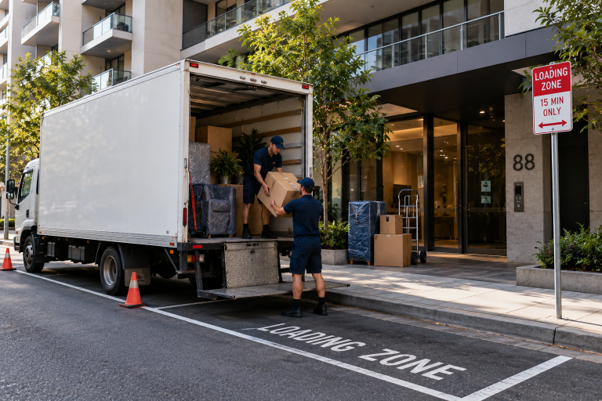
Often, yes, particularly in the City of Melbourne, Yarra and Port Phillip, where parking is tightly enforced and a standard loading zone won't give you enough time to complete a full move. Whether you need a permit and which type depends on your council, the street, and how long the truck needs to be there.
Council parking options compared
| Situation | What Usually Applies | Who Issues It |
|---|---|---|
| Short stop under an hour, dedicated loading zone available nearby | Use the loading zone directly (time limited, no permit needed) | N/A, enforced by council |
| Longer move, no loading zone, or standard restricted parking (2P, 1P, metered) | Reserved Parking Permit, which temporarily overrides normal restrictions for a specific bay | City of Melbourne (other councils have similar schemes under different names) |
| Truck needs to occupy footpath, laneway or more than a standard bay | Street occupancy or construction/works permit | Local council, often needs a site plan |
| Heavy vehicle over 4.5 tonnes GVM or 7.5 metres | May be subject to Heavy and Long Vehicle Parking local laws, though delivery and service activity is often exempt | Local council |
In the City of Melbourne, a Reserved Parking Permit temporarily overrides restrictions such as No Standing zones or short-term ticket limits so a removalist truck can legally occupy a specific bay for the approved window.
Applications should generally go in at least five business days ahead of the move to allow processing time and, where relevant, installation of temporary signage. Residents applying for parking directly outside their own address may be eligible for a discount, commonly around 50 percent, on presentation of proof of residency.
A few practical points that catch people out:
Many professional removalists will apply for the permit on your behalf as part of the booking, since they deal with council portals regularly, but it's worth confirming this explicitly rather than assuming it's included.
Apartment moves tend to run in fixed blocks rather than the open-ended flow of a house move, because your lift slot, dock allocation and parking permit all have set windows. A simple structure that works for most one or two bedroom apartment moves:
If you're moving out of a walk-up building with no lift, budget significantly more time. Stairs realistically add 30 to 60 minutes per flight once you factor in narrow turns and the need to disassemble large furniture that won't make the corner, and adding an extra person to the crew tends to cut that time meaningfully rather than just being a nice-to-have.
Three weeks before:
Two weeks before:
One week before:
Moving day:
An apartment move in Melbourne isn't harder than a house move because there's more furniture. It's harder because there are more people who need to say yes before the truck can start loading. Lock in the lift booking, get owners corporation approval in writing, confirm where the truck is legally allowed to park, and the actual moving part becomes the easy bit.
Do all Melbourne apartment buildings require a lift booking?
Most do, particularly buildings with a single shared lift or a dedicated goods lift, since access is treated as shared infrastructure that has to be scheduled around other residents. Smaller or older buildings without a manager may still expect informal notice to whoever holds the lift key.
Who do I contact to book the lift, the owners corporation or the building manager?
Usually the building or facilities manager handles the day-to-day lift booking, while the owners corporation or its managing agent handles the formal move-in/move-out approval and any bond. In smaller buildings these can be the same person or committee.
Is a loading zone enough for a full apartment move?
Not usually. Loading zones are designed for short, active loading and are commonly time limited to around 15 to 60 minutes, which is rarely enough for a full apartment load. For anything longer, a proper parking permit is the safer option.
How far in advance should I apply for a parking permit?
In the City of Melbourne, at least five business days before your move date is the standard guidance, to allow for processing and any temporary signage. Other councils may have different lead times, so check directly if you're moving in Yarra, Port Phillip, Stonnington or a neighbouring municipality.
What happens if the removalist truck can't get a permit in time?
Your removalist may still be able to use a nearby loading zone for short active trips, ferrying items back and forth, but this adds time and cost compared with a reserved bay right outside the building. This is worth discussing with your removalist as a backup plan rather than a first option.
LOCATIONS & SUBURBS
From moving houses to office relocation services in records time, we’ve got the lowest removalist costs in Melbourne – Book your next move with us online today! For our interstate removalists – try Move4Cheap!
© Copyright 2024 - Melbourne Cheap Movers - All Rights Reserved | Designed, Marketing & Managed by Crazy Rise