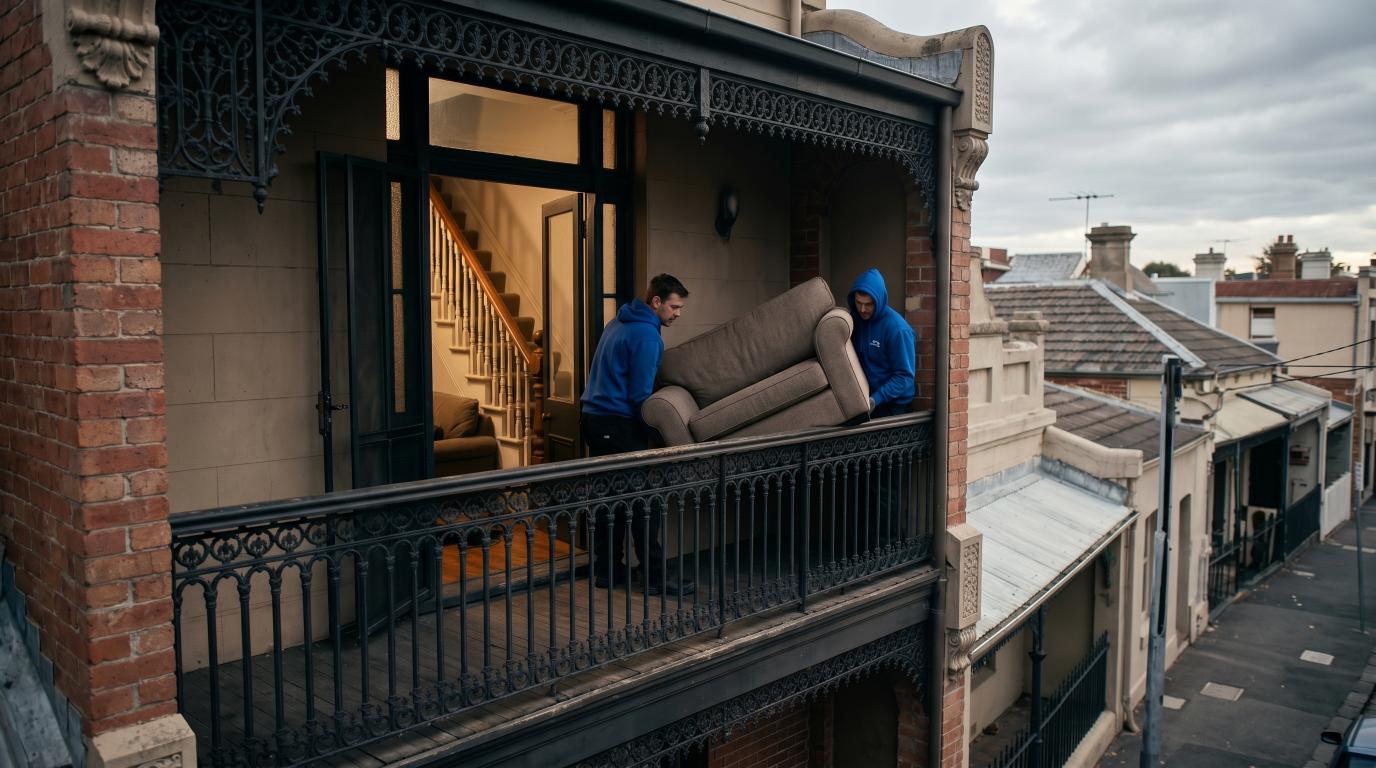
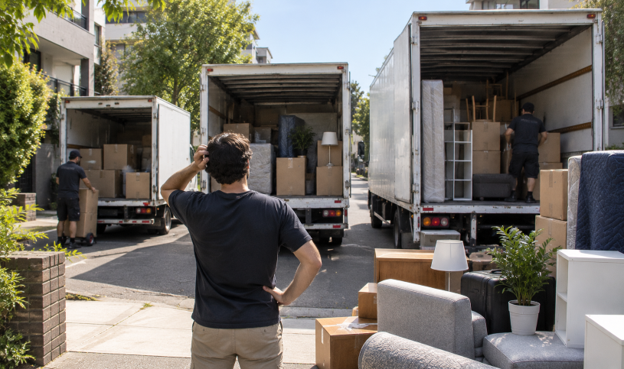
Melbourne apartment moves rarely fail because of bad luck. They fail because of a missed booking, a measurement nobody checked, or a rule nobody read until moving day. Unlike a house move, where the worst case is a slower morning, an apartment move can be stopped entirely by a locked lift, a blocked loading dock, or a building manager who turns your crew away at the door.
The most common apartment moving mistakes in Melbourne are: not booking the lift, ignoring loading dock rules, assuming parking will be free, not measuring furniture against doorways and lifts, forgetting to flag stairs, missing the building's approved moving hours, hiring the wrong size truck, packing badly for a multi-stage carry, and booking end of lease cleaners before the move is actually finished. Each one is avoidable with about a week of planning.
Below is what causes each mistake, why it costs Melbourne movers time and money, and exactly what to do instead.
1. Not Booking the Lift in Advance
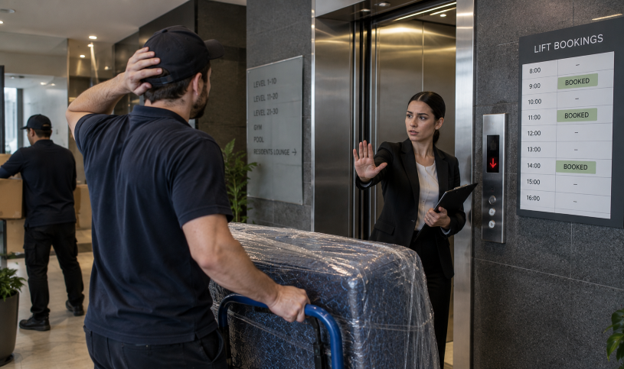
Most Melbourne apartment buildings will not let a removalist use the lift without a prior booking, and some will not release lift access at all if the slot has not been confirmed with the building manager. This is the single most common reason apartment moves stall before they start.
Buildings usually run this process through the owners corporation or an on-site building manager, and the request typically needs to go in one to three weeks before moving day, longer for larger towers in the CBD, Southbank or Docklands.
Many buildings also want a certificate of currency for your removalist's public liability insurance attached to the booking, and some limit the slot to a fixed window, often two to three hours.
- Contact the owners corporation manager or building manager as soon as you have a moving date, not the week before.
- Ask specifically whether the building uses a dedicated service lift or the passenger lift for moves, since some buildings do not allow furniture in the passenger lift at all.
- Send your removalist's insurance certificate with the booking request, before it is asked for.
- Confirm the exact start and end time of your slot in writing, and build in a buffer, since lift access is often cut off automatically once the booking window closes.
Consumer Affairs Victoria confirms that owners corporations in Victoria can set enforceable rules covering moving furniture and other objects through common property, where it affects other users. That means the lift booking process is not a courtesy from the building, it is a rule your building is entitled to enforce.
2. Ignoring the Building's Loading Dock Rules
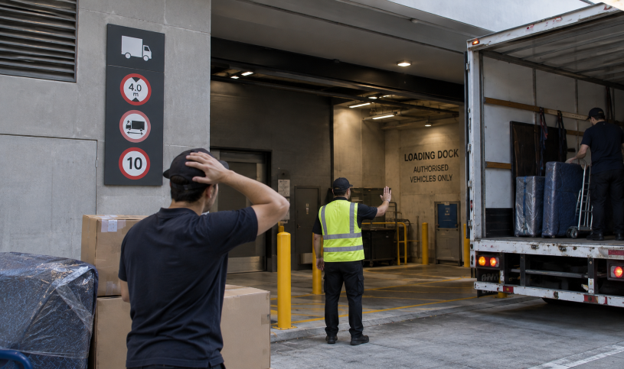
A loading dock booking is a separate requirement from a lift booking, and skipping it is one of the fastest ways to have a truck turned away on moving day.
Loading docks in apartment buildings are shared with deliveries, trades, and sometimes other residents, so buildings control access by height limit, time slot, and sometimes vehicle length.
Before you book a truck, find out the dock's clearance height (most standard moving trucks sit around 3 to 4 metres), whether the dock needs a separate booking from the lift, and whether other deliveries take priority during business hours.
Some buildings also restrict how long a vehicle can occupy the dock, which matters if your move involves multiple trips.
- Ask the building manager for the loading dock's height and length limits before confirming your truck size.
- Book the dock and the lift together, so both slots line up.
- Confirm whether the dock is first come first served for deliveries during your slot, or reserved exclusively for your move.
- If your building has no loading dock, ask what the alternative unloading point is, since some buildings direct movers to a side street or basement entry instead.
3. Assuming Parking Will Be Available
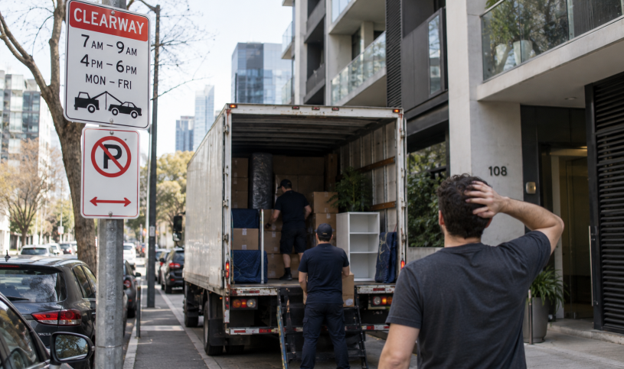
Assuming there will be a clear, legal spot for the truck right outside your building is the mistake that most often turns a simple move into an expensive one.
Inner Melbourne streets, especially in the CBD, Southbank, St Kilda Road, Carlton, Fitzroy and South Yarra, are heavily regulated with clearways, loading zones, metered bays and time limited parking, and a truck parked illegally can be fined or towed mid-move.
The City of Melbourne allows residents to apply for a reserved parking permit that temporarily reserves a bay, including in No Parking and Loading Zone areas, for activities like a house move.
The availability of reserved parking depends on the existing parking signs in the area, with parking bays reservable in permissive parking areas such as '2P Ticket', '1P Meter' and '1/2P' zones. Longer trucks need more than one bay: applicants requesting a permit for a vehicle over six metres must request enough bays to cover the whole vehicle, so a 20 metre truck and tailgate combination needs four bays reserved. (source)
- Check your street's parking signage in advance. Clearways within 20km of the CBD are strictly enforced tow-away zones during posted hours.
- Apply for a reserved parking permit through your local council (City of Melbourne, Yarra, Port Phillip, Stonnington and others each run their own process) at least one to two weeks ahead.
- Tell your removalist the truck's length so they can confirm how many bays or how much kerb space is actually needed.
- If you're a City of Melbourne resident, ask about the fee reduction available for removalist-related permit applications.
4. Not Measuring Sofas and Lift Doors
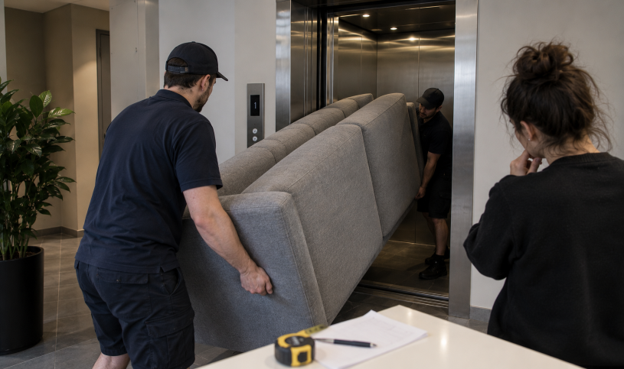
Skipping the tape measure is how a three-seater sofa ends up stuck sideways in a lift lobby. Apartment lifts, especially in older or boutique buildings, are often narrower and shorter than a standard house doorway, and some have a tight dogleg turn between the lift door and the corridor that a long piece of furniture simply cannot make.
Before moving day, measure three things: the internal width, depth and height of the lift car, the width of the lift doorway opening, and the width of your largest items (sofa, mattress, wardrobe, dining table) at their widest point, including any arms or legs that stick out.
Then check the diagonal measurement of anything close to the lift's dimensions, since a sofa that is too wide to carry flat can often still fit on an angle.
- Measure the lift car (width x depth x height) and the doorway opening, not just the lift's advertised capacity in kilograms.
- Measure your bulkiest items at their widest point and compare against the lift and any tight corners between the lift and your door.
- If something won't fit assembled, plan to disassemble it (sofa legs, bed frames, table legs) rather than discovering the problem on the day.
- If your lift genuinely cannot take a large item, ask your removalist about stair carries or a crane or hoist option for oversized pieces.
5. Failing to Mention Stairs
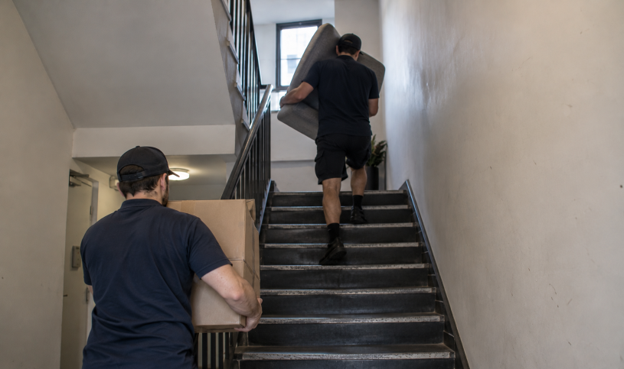
Not telling your removalist about a walk-up building, or a lift that's out of service, is one of the quickest ways for a quoted price and timeframe to fall apart. Stairs change everything about how a move is staffed and priced, because every trip up and down adds time that a lift-access move simply doesn't have.
As a rough guide, stairs add somewhere between 30 and 60 minutes per flight to a move, and that time compounds with distance from the truck to your door. A two-bedroom walk-up on the third floor genuinely needs a different crew size than the same apartment with lift access, because more people moving in parallel cuts stair time significantly compared with two movers doing it alone.
- Tell your removalist the exact number of flights, and whether there's a lift as a backup if it's out of service on the day.
- Mention the distance from the truck's likely parking spot to your front door (a long carry adds time in the same way stairs do).
- Ask whether large or heavy items (wardrobes, king beds, large sofas) will physically make the stairwell's turns, and disassemble in advance if not.
- Expect a walk-up move to cost more in labour time than the same job with lift access, and factor that into your budget when you compare removalist quotes.
6. Not Checking Building Moving Hours
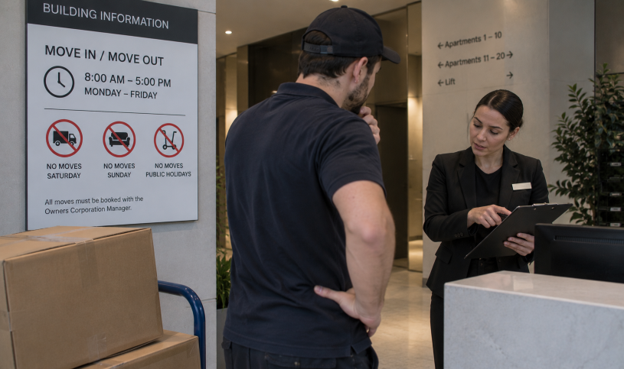
Assuming you can move any time that suits you is a mistake in almost every Melbourne apartment building, because most owners corporations set fixed hours for moves to limit noise and disruption to other residents. Common restrictions include weekday-only moves, no moves before 8am or after 5 or 6pm, and no moves at all on Sundays or public holidays in some buildings.
These hours are usually set out in the building's move-in and move-out procedure, which you can get from the owners corporation manager or on-site building manager. Booking a truck and crew before checking this is how people end up rescheduling a move at short notice, often at a higher cost.
- Ask for the building's written moving hours policy before you book your removalist.
- Confirm whether weekend moves are allowed at all, since some inner-city buildings restrict moves to weekdays only.
- Build a buffer into your booked time slot in case the move runs long, since going past the approved window can mean losing lift access mid-move.
- If your building only allows a narrow midweek window, look at a last minute removalist service if your schedule needs to shift quickly.
7. Choosing the Wrong Truck
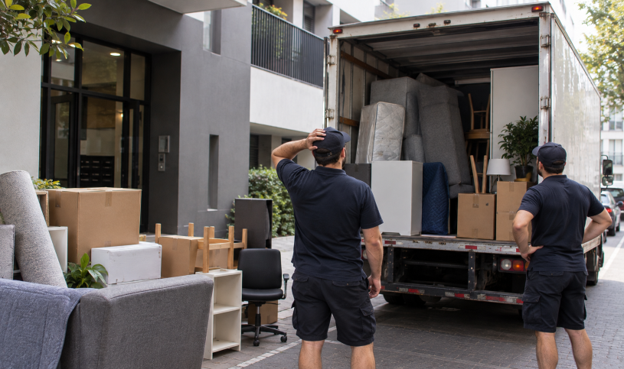
Booking a truck based purely on the number of bedrooms, without accounting for building access, is a common and costly mistake.
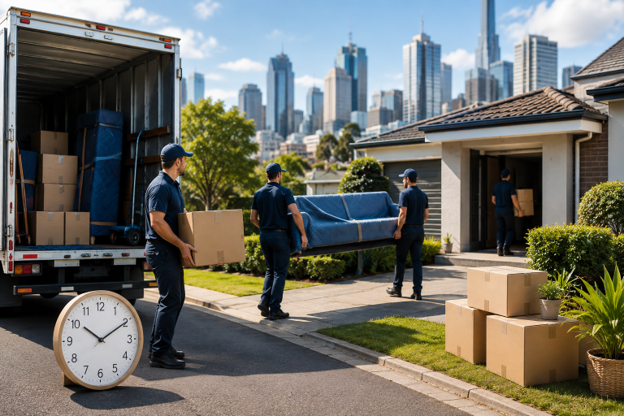
A truck that's the right size for a house move can be too long to park near a CBD apartment, too tall for a loading dock, or simply more truck than the job needs if a lot of the move happens via lift and trolley rather than direct truck-to-door carrying.
| Move size | Typical truck | Best suited to |
|---|---|---|
| Studio or 1 bedroom apartment | 3 tonne truck | Small loads, tight street access, single lift trips |
| 2 to 3 bedroom apartment | 6 tonne truck | Standard apartment moves with lift or short walk-up access |
| 4+ bedroom or office | 10 tonne truck | Larger volumes, best suited to houses or buildings with a proper loading dock |
The right choice depends on three things: how much you're moving, how the truck will actually get your items from the kerb to your door (lift, stairs, or a long corridor), and whether the building's dock or street access can even fit a larger vehicle. An experienced local team can usually recommend the right size once they know your building's access, which is one reason a fixed inventory list and building details matter more for an apartment quote than for a house quote.
8. Poor Packing for a Multi-Stage Apartment Move

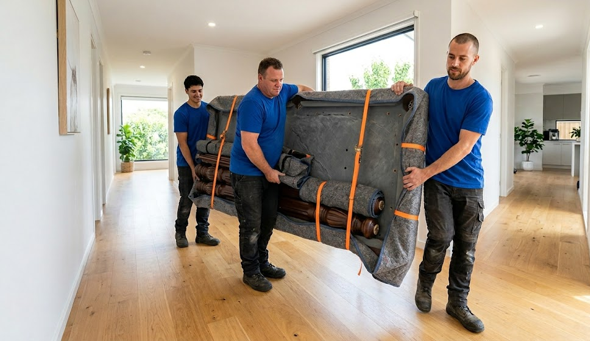
Packing the way you would for a house move, in large heavy boxes with no thought for how items will actually travel, causes real problems in an apartment move because the journey has more stages: from your unit to a trolley or lift, from the lift to the truck, and often back through the same sequence at the other end. Every extra handling stage is a chance for something to be dropped, scratched or crushed.
Loose, overpacked boxes are harder to stack safely on a trolley, and fragile items without proper cushioning don't survive multiple lift trips and tight corners as well as they'd survive a single carry to a truck parked in a driveway.
- Keep boxes to a manageable weight (medium boxes, roughly 3 cubic feet, are the standard size for a reason) so they're easy to trolley through lifts and corridors.
- Wrap and box fragile items individually, don't rely on soft furnishings alone as padding.
- Photograph valuables and existing furniture condition before the move, since apartment buildings with a bond or damage deposit will expect proof of pre-existing condition if there's a dispute.
- Label boxes by room and by "first off the truck" priority, since apartment unloading often has to happen in a tighter time window than a house unload.
9. Scheduling Cleaners Too Early
Booking your end of lease cleaners for the same morning as your move, or worse, before your move is even finished, is a mistake that regularly costs renters part of their bond. Cleaners need an empty apartment to do the job properly, and if boxes or furniture are still being carried out when they arrive, either the clean gets rushed or you pay for a return visit.
Apartment moves also tend to run longer than expected because of lift bookings, stairs, and loading dock timing, all of which push back your actual "empty apartment" time compared with a house move.
- Book cleaners for the afternoon or the following day, not back-to-back with your move slot.
- Build in at least a 90 minute buffer between your last item leaving and the cleaners arriving, longer if your building's lift access is tight.
- Do a final walkthrough yourself before the cleaners arrive, checking cupboards, balconies and any storage cage separately from the main apartment.
- If your lease requires a professional clean receipt for bond return, confirm the booking includes that documentation.
A Simple Pre-Move Timeline for Melbourne Apartments
| Timeframe | What to do |
|---|---|
| 3 to 4 weeks before | Book your removalist, confirm truck size based on building access |
| 2 to 3 weeks before | Request lift and loading dock bookings from the building manager, send insurance certificate |
| 1 to 2 weeks before | Apply for a council parking permit if needed, measure large furniture against the lift and doorways |
| 1 week before | Confirm the building's approved moving hours and your exact lift/dock time slot |
| 2 to 3 days before | Finish packing, label boxes, photograph valuables and furniture condition |
| Moving day | Arrive early, confirm access with the building manager, do a final walkthrough |
| After the move | Book end of lease cleaners with at least a 90 minute buffer after the last item leaves |
Conclusion
Nearly every apartment moving mistake on this list comes down to the same root cause: treating an apartment move like a house move with an extra step, instead of a move that runs on someone else's schedule and rules. Booking the lift, dock, and parking early, measuring before you commit to a truck, and giving your building the details it actually asks for turns a stressful day into a straightforward one.
If you'd rather hand the planning over, our team at Melbourne Cheap Movers works with apartment buildings across the city every week and knows how to plan around lift bookings, loading docks, and council parking rules. As experienced movers in Melbourne, we can help you choose the right truck for your building's access and get you a clear fare estimate before moving day.
Frequently Asked Questions
How much notice do I need to book a lift for an apartment move in Melbourne?
Most owners corporations ask for one to three weeks' notice, though larger CBD and Docklands towers with high move volume often need closer to three weeks. Always confirm directly with the building manager rather than assuming a standard timeframe.
Do I need a parking permit to move into a Melbourne apartment?
In most inner Melbourne areas, yes, if you want guaranteed legal parking for the truck. Councils including the City of Melbourne offer reserved parking permits that temporarily reserve a bay, and these can even apply in No Parking and Loading Zone areas in permissive parking zones, but they need to be applied for in advance.
What size truck do I need for a 2 bedroom apartment?
A 6 tonne truck typically covers a 2 to 3 bedroom apartment move, but building access matters as much as bedroom count. A tight CBD street or a low loading dock clearance can mean a smaller truck is the safer choice even for a larger inventory.
Can a building refuse to let my removalist use the lift?
Yes. Owners corporations can set rules covering moving furniture and other objects through common property, where it affects other users, and buildings can withhold lift access if a booking, insurance certificate, or approved time slot hasn't been arranged in advance. Consumer Affairs Victoria.