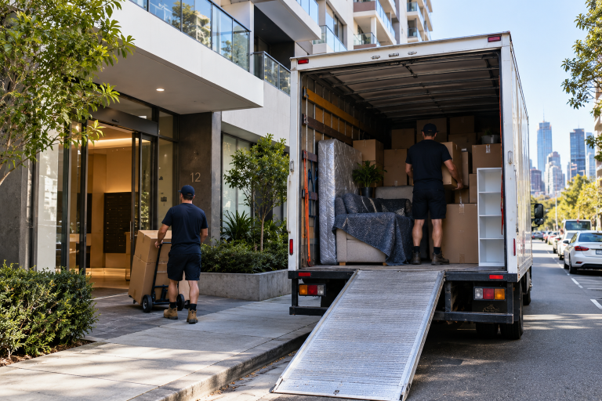
Booking the wrong size truck is one of the most common (and most expensive) moving mistakes. Too small, and your removalist has to run a second trip, which means extra hours on the clock. Too big, and you're paying for space and fuel you never used.
The short answer: a 1-bedroom unit typically needs a van around 10 to 12 cubic metres, a 2-bedroom home needs a truck around 20 to 28 cubic metres, and a 3 to 4-bedroom house needs a truck between 35 and 50 cubic metres. Most movers in Melbourne, including our team, size the job by cubic metres of furniture rather than bedroom count alone, since two "2-bedroom" homes can hold very different amounts of stuff.
How Removalists Actually Size a Truck
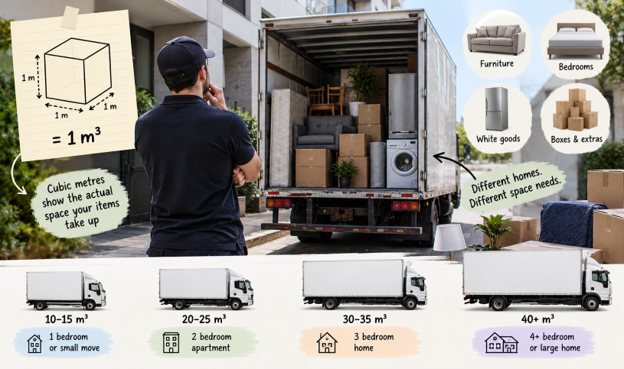
A cubic metre (m³) is a space one metre long, one metre wide and one metre high. It's the standard unit the Australian removals industry uses to price jobs and match loads to trucks, because it accounts for the actual volume of your belongings rather than a rough label like "2-bedroom."
Two households with the same number of bedrooms can need very different trucks.
A share house with minimal furniture might fill 12 m³, while a family home with a home gym, extra wardrobes and a garage full of tools could hit 35 m³ in the same "2-bedroom" category.
That's why the tables below give ranges, and why it's worth telling your removalist about anything outside the usual furniture list (garage contents, a spare fridge, exercise equipment) before moving day.
Truck Size by Move Type
Here's how Melbourne Cheap Movers' fleet lines up against typical Melbourne home and office sizes. These figures reflect our actual vehicles and the general capacity ranges the moving industry uses for vehicles of the same class.
| Vehicle | Approx. capacity | Internal dimensions | Best for |
|---|---|---|---|
| 2 Tonne Van | ~10–12 m³ | Compact van body | Studio, single room, few furniture items, small unit |
| 4 Tonne Truck | ~20 m³ | 4.2m L × 2.1m W × 2.2m H | 1 to 2 bedroom homes |
| 6 Tonne Truck | ~25–28 m³ | Mid-size box truck | 2 bedroom homes with extra furniture |
| 8 Tonne Truck | ~35 m³ | 6.0m L × 2.4m W × 2.4m H | 2 to 3 bedroom homes |
| 10 Tonne Truck | ~50 m³ | 7.4m L × 2.5m W × 2.6m H | 3 to 4 bedroom homes |
Dimensions for the 4, 8 and 10 tonne trucks are based on our current fleet.
The 2 and 6 tonne figures are approximate, standard ranges for vehicles of that class. Always confirm exact truck availability when you book on our prices page.
How Much Space Do Individual Furniture Items Take Up?
If you're moving a smaller load, such as a share house room or a handful of items into a new place, it's often more useful to add up individual pieces rather than think in bedrooms.
AFRA, the peak body for the Australian removals industry, confirms that a removal quote is based on a full inventory of the items being moved, rather than a bedroom count alone. Individual item volumes vary by size and configuration, but the following ranges give a realistic starting point.
| Item | Approx. volume |
|---|---|
| Three-seater sofa | 1.5–2 m³ |
| Dining table with 6 chairs | 2–3 m³ |
| Queen bed (frame, mattress, base) | 2.5–3 m³ |
| Double wardrobe | 1.5–2 m³ |
| Fridge (standard) | 1.5 m³ |
| Washing machine or dryer | 1 m³ |
| Chest of drawers | 1 m³ |
| 6 packed moving boxes | 1 m³ |
Add these up against the truck capacities in the table above, and you'll get a realistic idea of what fits. As a rule of thumb, a full bedroom's worth of furniture, including a bed, wardrobe and drawers, averages around 5 to 7 m³, and a standard living room with a sofa, coffee table and TV unit adds another 4 to 6 m³.
If you're only shifting a few large items rather than an entire home, man with a van style service and 2 tonne van are usually enough, and it's the most cost-effective option for that scale of job.
1-Bedroom Move: What Size Truck Do You Need?
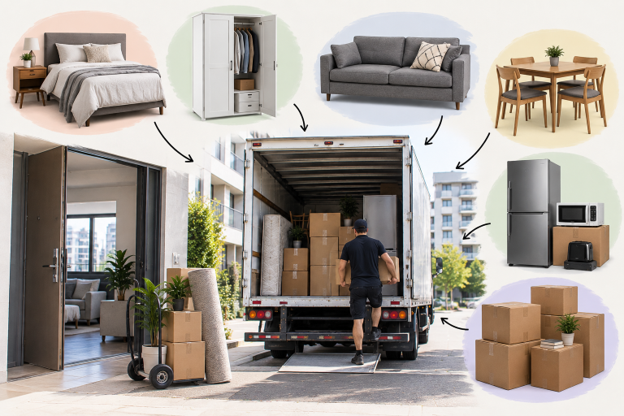
A typical 1-bedroom unit needs a truck in the 10 to 20 m³ range, which covers a 2 to 4 tonne van depending on how furnished the home is. A minimally furnished share room might fit in our 2 tonne van, while a fully furnished 1-bedroom apartment (bed, wardrobe, sofa, dining setup, whitegoods) is safer booked with the 4 tonne truck.
What typically fits in this move:
- Queen or double bed, mattress and bedside tables
- Wardrobe or built-in storage boxes if disassembled
- Sofa or small lounge suite
- Small dining table and chairs
- Fridge, microwave and small kitchen appliances
- 15 to 25 packed boxes
2-Bedroom Move: What Size Truck Do You Need?
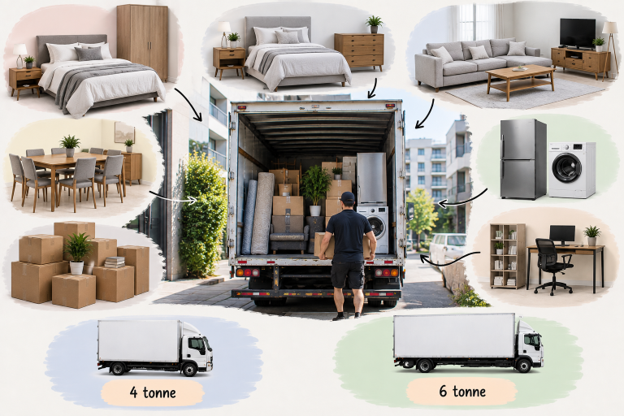
Most 2-bedroom homes in Melbourne need somewhere between 20 and 30 m³ of truck space, which puts you in our 4 tonne or 6 tonne range. If you've got a second living area, a study setup, or extra storage furniture, lean toward the 6 tonne truck to avoid a second run.
What typically fits in this move:
- Two bedroom suites (beds, wardrobes, drawers)
- Full lounge suite and entertainment unit
- Dining table and 6 chairs
- Kitchen whitegoods (fridge, washing machine)
- Home office desk and chair
- 30 to 45 packed boxes
Both a 4 tonne van and a 6 tonne truck for 2-bedroom homes are reccomended, since furnishing levels vary this much between households.
3-Bedroom Move: What Size Truck Do You Need?
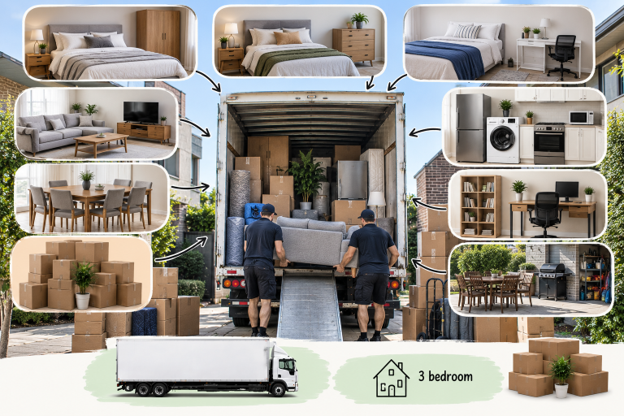
A furnished 3-bedroom house generally sits between 30 and 40 m³, which is where our 8 tonne truck comes in. Its 6.0 metre long, 2.4 metre wide, 2.4 metre high load area holds approximately 35 m³, enough for three full bedroom suites plus living and dining areas in a single trip.
What typically fits in this move:
- Three bedroom suites
- Full lounge and dining room
- Full kitchen, including whitegoods
- Study or home office furniture
- Outdoor furniture or a small garage load
- 45 to 60 packed boxes
If your 3-bedroom home also has a large garage, a home gym, or a lot of outdoor furniture, it's worth mentioning this when booking, since it can push you toward the 10 tonne truck instead.
4-Bedroom Move: What Size Truck Do You Need?
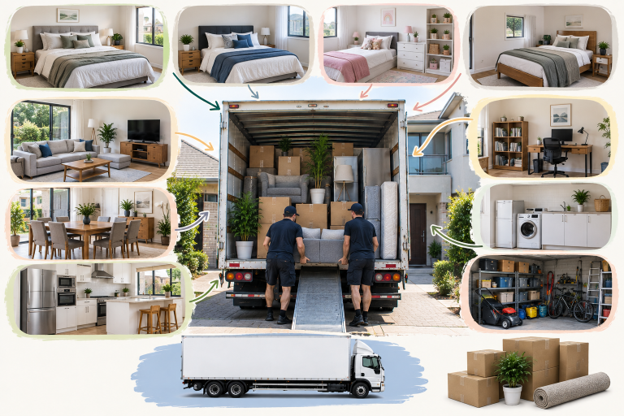
A 4-bedroom family home typically needs 40 to 50 m³, matching our 10 tonne truck. At 7.4 metres long, 2.5 metres wide and 2.6 metres high, it's built for full family homes with four bedroom suites, multiple living areas and a garage's worth of extras.
What typically fits in this move:
- Four bedroom suites
- Multiple living and dining areas
- Full kitchen and laundry appliances
- Home office or study
- Garage contents (tools, bikes, storage shelving)
- 60+ packed boxes
Garages are the item most people underestimate. A "normal" garage with tools, bikes and a mower can quietly add another 5 to 8 m³ on its own, so if yours is fairly full, flag it when getting your quote so the 10 tonne truck is sized approximately for your load.
Office Move: What Size Truck Do You Need?
Office removals don't follow the same bedroom logic as home moves, since the truck size depends on desk and workstation count rather than square metreage. A small office with 5 to 10 workstations usually fits a 4 to 6 tonne truck, while a larger office with 15 or more workstations, meeting rooms and storage cabinets needs an 8 to 10 tonne truck, often with multiple trips for larger fit-outs.
What typically needs to be moved:
- Workstations, desks and office chairs
- Filing cabinets and storage units
- Boardroom tables and meeting room furniture
- IT equipment and monitors
- Reception and breakout area furniture
Because business downtime is expensive, office moves usually benefit from a dedicated project manager and a plan that minimises disruption rather than the cheapest possible truck. Our Office Removals Melbourne service is built around exactly this, and for heavier equipment like server racks or industrial machinery, our forklift movers service handles the load safely.
What Else Changes the Truck Size You Need?
Bedroom count and furniture volume get you most of the way to the right truck, but a few extra factors commonly push a move into the next size up.
- Storage units or garages: These are the most commonly forgotten space. Add them to your estimate separately.
- Stairs and access: Not a volume factor, but worth mentioning early since it affects crew size and time, not truck capacity.
- Disassembly: Furniture that isn't broken down (bed frames, flat-pack wardrobes) takes up more awkward space than the same item disassembled.
- Extra whitegoods: A second fridge or a chest freezer can add 1.5 to 2 m³ that's easy to miss when estimating from bedrooms alone.
- Combined moves: If you're merging two households into one, add both estimates together rather than assuming one truck size covers it.
Consumer Affairs Victoria notes that removalists are required under Australian Consumer Law to provide services with due care and skill, so a reputable Melbourne removalist should ask about these factors upfront rather than leave you to guess.
Getting the Right Truck for Your Move
The fastest way to get an accurate truck size isn't guesswork, it's a quick conversation with your removalist about what's actually in your home. Bedroom count is a useful starting point, but garages, storage units and how furnished each room is will shift the number up or down.
If you're ready to lock in a size, check current rates for every truck in our fleet on the Prices page, or get a tailored recommendation through our Get Fare Estimate calculator.
Frequently Asked Questions
Is it cheaper to book a smaller truck and do two trips?
Usually not. A second trip adds travel time and labour hours on top of the original job, which almost always costs more than booking the correctly sized truck from the start.
Can I mix a van and packing service for a 1-bedroom move?
Yes. Many 1-bedroom moves in Melbourne combine a 2 tonne van with a packing service, since the packing labour (from $60 per hour per packer) is often the bigger time saver than the truck itself.
How do I know if I need an 8 tonne or 10 tonne truck?
If your home has three full bedrooms plus a modestly furnished living and dining area, the 8 tonne truck usually covers it. If you've also got a garage, a study, or outdoor furniture to move, the 10 tonne truck gives you a safer buffer.
Do I need to empty cupboards and drawers before the move?
This varies by removalist and item weight, but it's generally a good idea for anything fragile or heavy, since it also affects the total volume calculation for your truck.